Kali, Sunita and the toilet paper
"You’ll need to pay me for early check-in."
"What time is check-in?"
"Three."
"I’m arriving at five past three."
That’s how I met Maharaja.
I arrived in Kolkata for two and a half days on my way to get a visa stamp in Bangkok.
As always, at the worst possible timing, precisely when a vacation made the least sense, I found myself boarding another flight, on my way to discover yet another new city while my schedule was already burning with tasks.
But Kolkata?
She didn’t care.
Now you’re mine.
Now you stop.
You’ve already come all this way, she explained her logic.
So what, just to get stuck behind screens again?
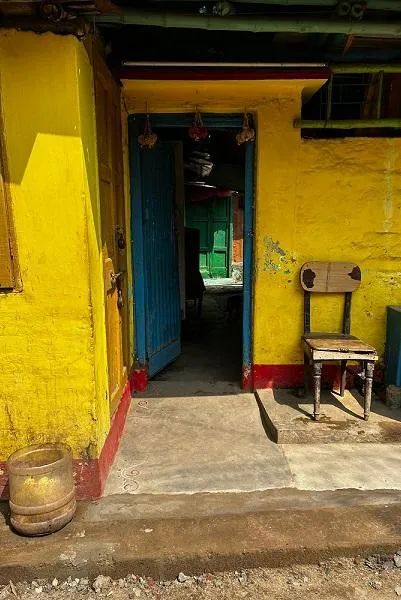
Kolkata welcomed me with a bold sunflower yellow that met me everywhere.
Welcome to the City of Joy, a large sign greeted me.
And Kolkata?
She lives up to that definition beautifully.
Everything in this city dances to its own rhythm.
The rhythm of the Ganga, the sacred river.
It turns out there are many kinds of chaos,
and in India I’m learning to tell them apart.
There’s the masculine chaos, the one I know so well from Bangalore.
Let’s work hard.
Let’s grind ourselves to death.
Let’s reach the edge and finish it.
The kind that drills.
The kind that builds.
The kind that always wants more and is never satisfied.
And then there’s the feminine chaos.
Round and soft.
Flowing like the river water.
Spinning like a dance.
Then disappearing.
Cyclists move lazily through colorful alleyways,
and the feeling is that you’ve entered a dimension where time behaves a little differently.
Pilgrims from all over India come to bathe in the sacred river
and wash away the tension their bodies have been carrying,
while the sun embraces everyone in deep shades of gold.
I took an Airbnb for two days in a quiet neighborhood within walking distance of the river
and the main celebration of Kali.
Kolkata is the city of Kali
the goddess of nature, destruction, the heavenly mother.
The woman who once lived in her full power,
connected to her nature,
daring to roar.
Women today have learned to be civilized.
Learned to obey the rules of society.
But Kali?
She roars.
And her roar is impossible to miss.
Kali does not keep quiet.
She does not swallow her words.
She does not shrink.
She does not fall silent.
Kali cuts off heads.
Kali shakes the ground.
Wild.
Present.
Feminine power as it existed in ancient times.
Before a patriarchal culture pressed the mute button.
Before it graded, measured, disciplined,
and labeled women as too much or not enough.
Kali is wild.
Primal.
Defiant.
You cannot mistake her.
She doesn’t need business cards
or apologies.
Because her power
with words or without
is felt in the body
in the belly
in the soul.
Early in the morning I set out to visit the ancient temple of Kali in the north of the city.
A one-hour Uber ride through sleepy streets after yet another vibrant night.
A temple visited by thousands of devotees every single day,
a thriving industry of money and massive chains of bright red hibiscus flowers dipped in blood.
And it’s unsettling.
The blood comes from animal sacrifice,
just like in the ancient Temple on the Temple Mount.
A pagan ritual that doesn’t exactly align with my vegan tendencies.
And yet, I decided to breathe it in.
To observe everything without judgment.
The experience?
Shaking.
A few minutes are enough to penetrate the soul.
Compared to pale, disciplined, overworked Bangalore,
Kolkata roars her existence in vibrant color and says:
I’m here, darling.
And nobody educates me.
I am here to be wild.
Right after leaving the temple,
I noticed flyers on street poles.
Sunita, with curly hair,
will fulfill any wish if you just call her.
Come on, pick up the phone.
Sunita is here for you, sweetheart.
And I found myself thinking
that all of us, men and women alike,
exist somewhere on that spectrum.
Between Kali
the powerful one who knows her strength
whose single call can destroy illusions and create new worlds
and Sunita
the one who forgot her voice
the one whose voice was silenced for generations
the one who began telling stories from her throat that belonged to others
pleasant stories
pleasing stories
as if they were her own.
That evening I returned to the apartment
to discover there was no toilet paper.
Welcome to India.
"You’ll need to take care of your own drinking water, the filter is broken.
And toilet paper as well,"
the landlord told me in the familiar Indian tone I already knew so well.
Maharaja was a young man in his early thirties
who made his living, among other things, from renting out his properties.
Made his living, meaning:
Please leave as quickly as possible
and cause me as few problems as you can.
And toilet paper
is a problem.
Indians don’t believe in toilet paper.
Just shake it off, why make a big deal?
But me?
I’m not Indian.
I stood in the middle of the room
staring at my phone.
To write
or not to write?
That was the question.
In days when everyone is already fighting with everyone,
the last thing I wanted was another battle.
Why make an issue out of this?
I’m only here for two days.
Tomorrow I’m leaving anyway.
And it’s only thirty rupees.
I can manage.
I can stay quiet.
I can let it go.
Nothing here is life or death.
Be grateful the air conditioner works in forty-degree heat.
Everything else is a bonus.
And the truth?
I was tired.
I didn’t have the energy for another conversation.
Another request.
Another moment of being that petty woman who gets stuck on toilet paper.
But then I saw the two voices.
Kali was there.
And Sunita was there too.
Kali was silent.
And it was actually Sunita who asked me:
What are you choosing?
To manage
or to speak.
And in that moment
I chose to speak.
Not to be angry.
Not to fight.
Not to threaten.
To speak
quietly
clearly.
To address him from my inner Kali
who knows her place
and not from Sunita
whose voice had been silenced.
And men?
They know exactly how to sense
when a woman is angry from connection to her power
and when she is angry from insecurity or overwhelm.
And when a woman speaks from her Kali
from her voice
no longer muted
the man becomes the loyal servant of her wishes.
Not from weakness.
Not from submission.
Not from fear
or guilt
or appeasement.
Quite the opposite.
From the purest masculine instinct
to serve the woman.
From the birth of the knight within him.
Half an hour later
a package arrived
dish soap
toilet paper
the deluxe emergency version
and a delivery man carrying six bottles of water
showed up at my door.
From that moment on,
Maharaja was attentive and present.
How can I serve you?
What do you need from me now
so you can feel comfortable
as the queen that you are?
Kali taught me the important lesson
between
Fiercely
and
Fearlessly
Fearlessly
is acting without fear
proving to myself that I can
Fiercely
is acting from connection
even when there is fear
even when I’m tired
even when it’s only thirty rupees
It wasn’t a grand act of courage.
It was a small moment
when I chose Kolkata
and chose my voice.
Not to give up on it.
And that small choice
made a big difference.
Thank you, Kali.
We will meet again.
